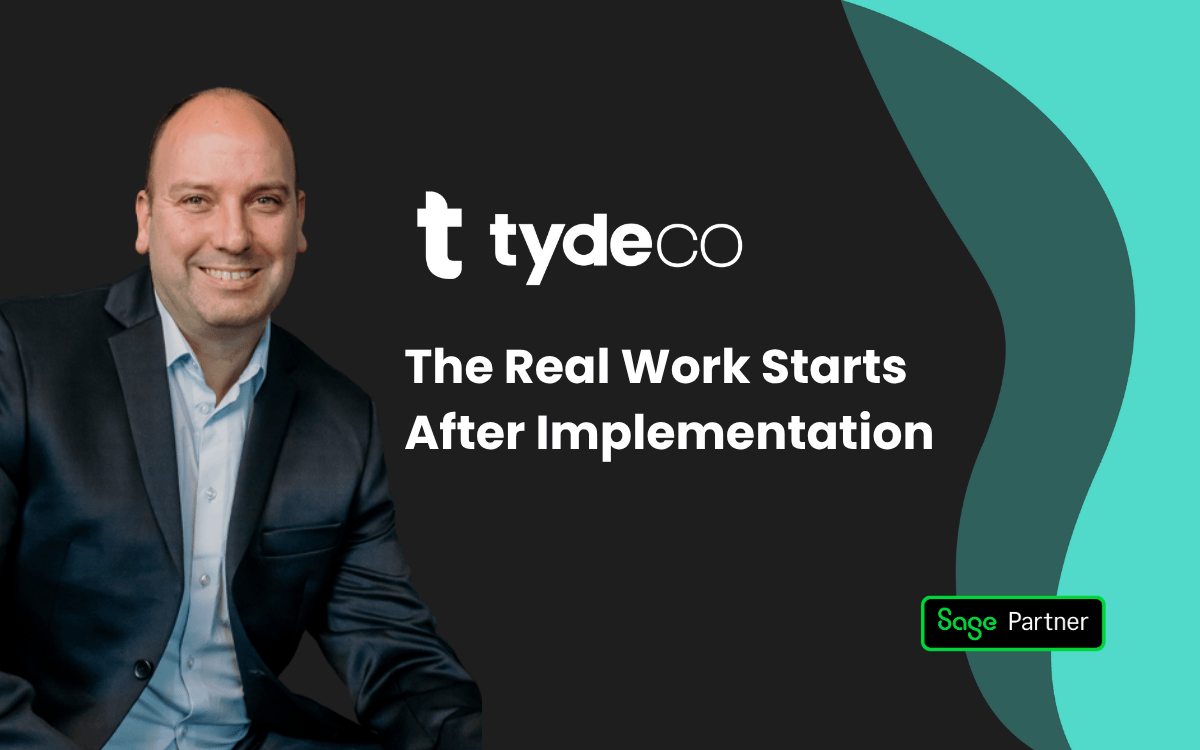

Let’s talk liquidity. Not in theory, but in timing gaps, missed signals, and the operational drag that builds when finance gets stuck reacting. It’s rarely about one system or one person—it’s about how everything fits together. That’s what Matt Lescault, CEO of TydeCo™, sees most often. He works with CFOs who are managing more complexity, faster cycles, and growing pressure to see ahead rather than look back.
But foresight doesn’t come from intuition. It comes from structure. From process. From knowing when to reconcile and when to act. In Lescault’s view, many finance teams still carry the habits of a slower era: batch thinking, end-of-month cleanups, and systems that can’t talk to each other. The tools are better now. The challenge is using them intentionally.
In this conversation, Matt Lescault explains what forward-looking really means for a CFO trying to manage liquidity with more confidence. He talks through real-time reconciliation, the shift from cash handling to cash architecture, and how nonprofit finance teams can build more predictability even when funding cycles are erratic. He also weighs in on the next shift in planning, why AI needs guardrails, and what it really takes to move from scrambling to steady.
When AI Has to Prove Itself
Question: In your last episode with Dan Miller, he talked about trust labels and audit trails for AI-driven cash forecasting in Sage Intacct. From your perspective, how do those features change the game for CFOs, especially those who have been burned by black box systems in the past?
Matt Lescault:
So I don’t know that I have any real experience in CFOs getting burnt by black box systems or anything of that nature historically.
What I would say is that training AI to perform, especially in a financial setting or an accounting setting, requires far more diligence when it comes to the results that you get. The reason is that when it comes to financial matters, especially audits and compliance, CFOs have to have a degree of guarantee that the information they’re being provided is accurate and actionable.
I think what’s really important around these trust labels and audit trails for AI is to show how the development of Copilot, whether in this circumstance with Intacct or Sage in general, actually works. Decoding how the training has been done and how the answers get formulated by the AI is key. A CFO or an operator of the system can go back and see the logic behind it.
This is really important from a trust perspective. I can’t just rely on asking the question and getting an answer. I need to know what went into the answer so that I can validate the process or the information that was provided.
From my side, these features really change the game for CFOs. Instead of digging for it, they can get an immediate answer, validate how that answer happened, and then execute on the action they want to take, whether that’s a recommendation to the CEO or leadership team, and so forth.
 Matt Lescault, Founder and CEO
What Forward-Looking Really Looks Like
Question: For CFOs trying to move from reactive cash handling to something more forward-looking, what advice do you usually give? Could you walk through a few steps that help them manage flow and timing with more confidence?
Matt Lescault:
I think most CFOs inherently want to look to the future, want to focus on the future, and want to provide consultative feedback to the organization based on where they believe the organization is going through data. Now, if we talk about cash flow specifically, that is one component of what would give a CFO information that they need to make a determination or make an opinion on what is the best next step for an organization.
That being said, I think that the advice that I would give is, how do we get outside of the concept of retroactive cash balancing to immediate cash reconciliation? Now, this is a concept that has been promoted very much by Sage in general. And what they talked about is kind of continuous, close. What they really mean by continuous close is that you’re truly tying out your financials in real time.
The concept is that we call it soft reconciliations in the AppSource accounting world, which involves daily, weekly, or semi-monthly reconciliations. We’re not actually reconciling with the system to make sure that we’re up to date on both cash and accrual level information so that if at any moment or within that kind of cadence, the client can really have the information at their fingertips.
The real advice comes into is if you can actually achieve that continuous close and you can achieve the ability to have on-demand information. Meaning what is transpiring right now in the business is recorded right now in the business means that you are making decisions right now on today’s information. I think I said “right now” one too many times in that, but there’s a reality there of that creates a competitive advantage that is unmatched when it comes to financial accuracy and financial decision-making.
Matt Lescault, Founder and CEOThe Features Are There; The Follow-Through Isn’t
Question: Sage Intacct’s cash management tools have become more sophisticated over time. Which features do you find most overlooked by finance teams, and how can they be used more intentionally to close the gaps between insight and action?
Matt Lescault:
So I don’t know what’s necessarily overlooked by the majority, but I can tell you that the amount of development that’s gone into Sage Intacct recently over the ability to streamline the close and create that continuous close is, my guess is that a lot of those new capabilities and new features aren’t being deployed currently by a lot of operators of Intacct.
Really, the increased development of Sage CoPilots and how that’s going to interact with the overall cash management tools, reconciliation, matching bank transactions, things of that nature. It means that that’s how we achieve, if we talk about what I just mentioned when it comes to what CFOs are trying to do and becoming more in real time, this is the foundational component of that.
If I’m the controller or a staff accountant and I’m able to operate within the cash close feature, one of the newer features that are coming out that is AI-deployed, now I’m actually helping achieve the goal of the CFO in the long run.
And I think for me, the gaps have a lot to do with the process. So I think the system itself, the features of Intacct are there, but your process as an organization, what are your steps and your tasks and reconciliation items, and what’s the cadence of that, is really important to the overall success of the utilization of that software, of those features.
And so for me, I think some of the more overlooked items are the updating of your internal processes. Think about your accounting policy procedures kind of documentation. Not that I think that’s the right way to approach it these days. There’s accounting close management software that really works as an interactive policy and procedures documentation.
But are we looking at the feature changes within the software and the systems that we’re using on a consistent basis, and based on what those feature enhancements are, are we looking at what our process is as an accounting department and adjusting to that so we always are becoming more efficient at what we’re doing?
I think that tends to be the most overlooked step in this, and why we don’t see as much adoption of feature-rich modules or feature-rich capabilities of those software.
Matt Lescault, Founder and CEOWhere Liquidity Issues Actually Start
Question: When you engage a client struggling with liquidity, where do the problems tend to sit? Are they typically rooted in system architecture, delayed reconciliations, poor sequencing, or another kind of structural issue? Feel free to bring in an example if it helps illustrate the mechanics.
Matt Lescault:
I find this to be maybe not a tough question, but a complex question.
Obviously, if we’re having liquidity questions, my first thing is like, are we earning enough revenue to support our costs? And are we overspending in areas? What are the metrics that we look at as an organization, industry-specific metrics of whether we’re hitting targets of what our peers are doing naturally within our industry?
Usually, what you find when it comes to liquidity has a lot to do with either top-line sales or a lack of understanding of what your target percentages are, and you’re not focused on that.
So we could say that system architecture could come into this, but I’ll tell you right now, a company very inefficiently could operate their accounting fully on Excel. I’d hate to do it. But that’s not going to change the revenue they generate and the money that they spend outside of their finance department.
Now, obviously the finance department would be overstaffed because it’d be so manual, but that’s not going to create your true liquidity. It’s going to be the cost of delivering your service or the cost of developing your software or something of that nature.
I would say that your structural issues within a finance department could highlight those things faster for an organization. And so if you have good architecture, if you have good process and so forth, it’s much easier for an organization to identify where their problems are.
But from a consulting perspective, it’s actually maybe a weird thing to say, but I don’t know that I would go right into software architecture within the finance department as my first avenue of a review to try to solve liquidity.
I’d probably go dually into RevGen and expense reduction and find out where we’re truly inefficient in the delivery of our products and services. And understand that a lot of businesses have multiple business lines. Sometimes it can be one or two business lines that are creating liquidity issues across the entire org that you just have to look at and decide whether or not that’s the right thing to operate.
So I think there’s more of an art to what we think of as kind of business turnaround services and identifying where we want to take action to solve that kind of thing.
Now, just to sort of put an asterisk on this whole thing, as soon as you solve the liquidity issue, you’re probably still not as profitable as you could be. But now you’re not trying to pay your bills and struggling to do that.
Once you solve the true liquidity issue at the very basic level of it, being able to operate in some form of reoccurring cash flow that’s consistent, then we start looking at that system architecture, at your finance department, saying, how do we structure something that is going to support our needs across all those other departments?
And now we go from worrying about liquidity to worrying about true gross profit and net income of the organization. And that is a game changer for business owners.
Matt Lescault, Founder and CEOFinance Habits That Make Nonprofits Vulnerable
Question: In the nonprofit space, where funding is often restricted or delayed, how do you help teams get a clearer line of sight on working capital and obligations? What system behaviours or reporting habits tend to shift first?
Matt Lescault:
There’s another one where I’m going to sort of deviate from the question. I’m going to come back to the question.
I believe in the concept of nonprofits having what I call an earned revenue component to their organization. And what that means is that it’s not dependent on grant donations or any type of funding from that perspective. If we can take a nonprofit and create a baseline of earned revenue—and there are different ways of doing this, and it’s not always possible with every nonprofit—but if we can do that, we can create a foundation of security for the organization.
Because like this question asks, we really talk about how you have timing delays potentially within grant receipt or funding receipt, but we have in current demands, current obligations around expense outflows. And sometimes that timing can be quite challenging for an organization.
Now, there’s a lot of vehicles out there to support this. If you have grants that are awarded and guaranteed, but timing can be an issue, you can get funding and financing through the bank. That’s very common around lines of credit and things like that, because you know that hey, month one, two, we’re going to be covering costs. We’re going to submit—I’m making the timing here—we’re going to submit our reimbursement and then get paid back on it. We just need float for that time period. Those kinds of things come into true finance management.
Sometimes we talk about accounting. Accounting is mostly debits and credits. Finance is how you actually manage your cash vehicles, your investment vehicles, and your overall debt funding, if you want to put it that way. And so nonprofits do have some unique needs around that management of cash flow.
And so we do want to see the teams be able to really understand that. When I say teams, they’re the finance departments within nonprofits, is understand exactly what the ebb and flow is.
I’ll give you a silly example. We shouldn’t be doing an annual budget that says we’re going to do five million in revenue and four million in direct costs and one million overhead. I’m just, again, making this up. We need to be looking at that on a month-to-month basis. Is January going to be a low month and then we pick up on February from a cash flow perspective and then we’re down in March? How does that ebb and flow work?
And the finance department really has to have a good feel for that and what that looks like because they should be able to tell the board, hey, here’s what we can expect. Here’s where we’re going to be light on cash. Here’s where we might need to get some pull on some vehicles that we have, like our line of credit, or we need to go into our endowment for a short period of time to fund it and do this in a very proactive manner, as opposed to a reactive manner.
No board wants to get an emergency meeting called because all of a sudden we can’t pay the bills. And that’s just a lack of planning if we have a balanced budget for the organization in an annual perspective.
Matt Lescault, Founder and CEOPlanning That Holds Up Under Pressure
Question: Looking ahead, what do you think will most influence how finance teams manage liquidity: better data flow, faster decisions, or a shift in how planning is approached?
Matt Lescault:
Liquidity has everything to do with timing, if you think about it. And so I think what will influence teams the greatest is going to be, how do we dive into the data to be able to, I’ve said this before, how do you use the data to make these decisions? How do you use the data to know when you’re going to have a change in liquidity needs? What’s going to be those impacts within the business that do it?
But I mean, at the end of the day, if you have a system that you’re closing in a continuous fashion or on an on-demand basis, and you know which information is today, if you have historic information that gives you guidance as to kind of what your ebbs and flows are from a sales apparatus, if that’s what you deal with as an organization.
If you have forecasting mechanisms that say, hey, if I do this, how does that impact me? So like if I hire this person, what’s that going to do to my bottom line?
If we have a foundation of the core information, if we’re using forecasting to look forward at it, and if we’re looking at reporting that analyzes historic, we bring that all together in a way to truly balance our decision-making around liquidity management. And so it’s like tying all the pieces together—you know, the past, present, and future in making our decisions.
Matt Lescault, Founder and CEOFinance doesn’t run on instinct. It runs on timing, trust in your numbers, and the systems that make that possible. As Matt makes clear, managing liquidity isn’t just about better forecasting: it’s about better fundamentals. Daily visibility. Continuous reconciliation. Processes that are built to scale, not patched together after the fact.
And while the tech is improving, it still comes down to how well teams adapt their practices. Whether it’s nonprofits dealing with funding lags or CFOs chasing real-time insight, the goal is the same: make decisions with confidence, not caution.