When it comes to scaling, the first thing companies normally consider is sales. But, behind every growth curve is a people problem – hiring faster than you can onboard, managing teams across locations, and trying to lead culture from a spreadsheet.
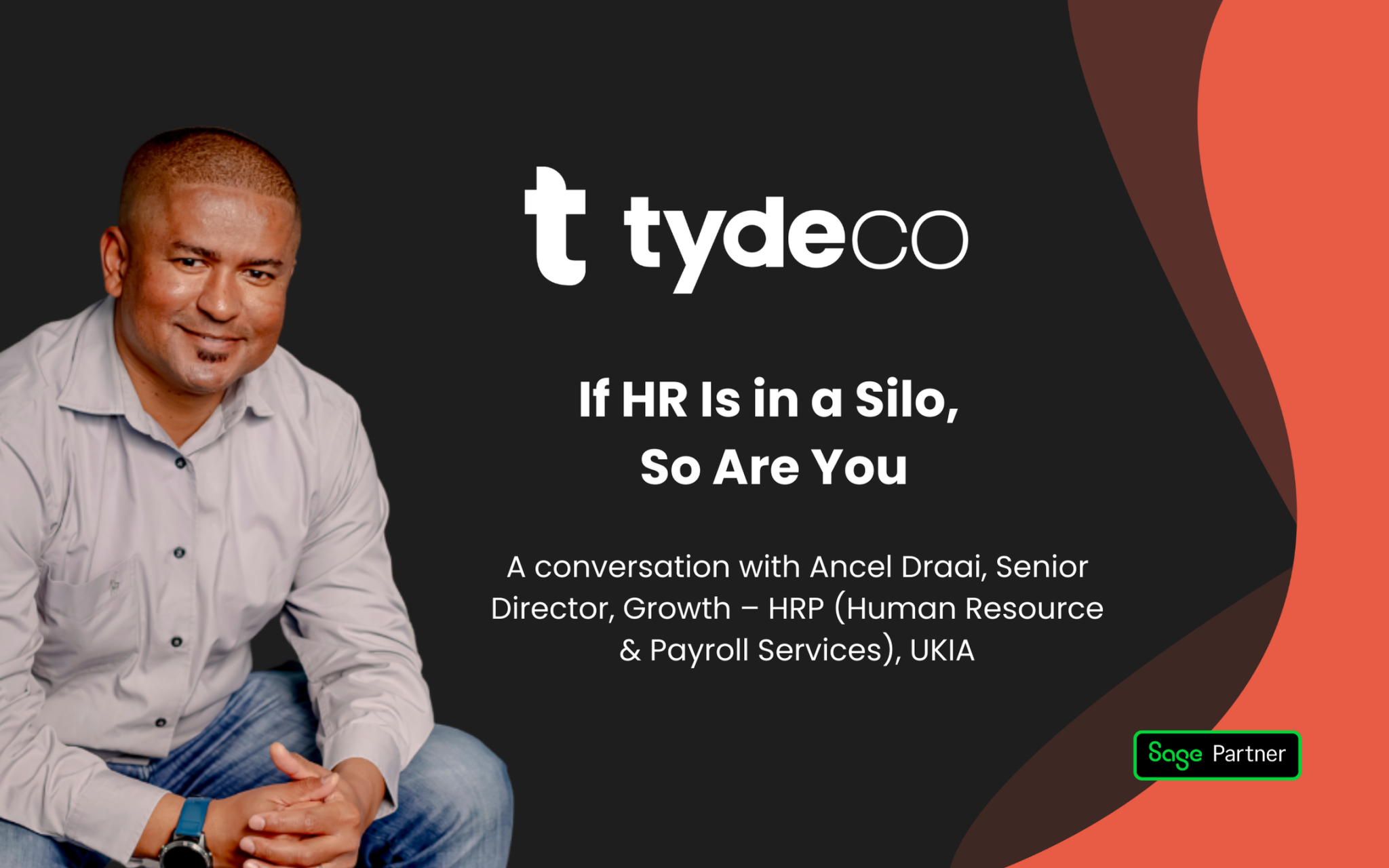
Senior Director of Growth for Human Resource & Payroll Services at Sage (UKIA), Ancel Draai, sees this play out on the daily, working with businesses that are growing rapidly, and sometimes painfully. In this conversation, he unpacks what’s changing in HR and payroll, what still holds companies back, and how integrated systems can help teams do more than just keep up.
Upgrading HR for Business Growth
When it comes to growth, HR systems need to evolve from just administrative tools for storing data into strategic engines that support both leadership decisions and employee engagement.
- Legacy systems trap data, they don’t return insights. However, utilizing advanced analytics allows us to better understand our current position and plan more strategically.
- Modern HR tools use automation and workflows that can replace outdated manual processes like handwritten leave requests with things like e-signatures and integrated approvals.
- Employee self-service tools enhance the user experience by allowing staff to manage their own leave requests, payslips, training, or policy access whenever they need to.
To scale with intention, your HR systems should offer analytics, visibility, and flexibility while also creating a more engaging experience for employees and leadership alike.
 Ancel Draai, Senior Director, Growth – HRP
Solving Disconnects Between HR, Payroll, and Finance
Question: Can you describe how TydeCo works with clients to ensure both client satisfaction and operational efficiency?
When your systems don’t speak to each other, your people pay the price – through duplication, confusion, and compliance risks that slow everything down, but consolidation can mitigate this.
- Unlike siloed systems, a unified system can minimize manual errors and security issues while reducing the need for double data entry, especially during the onboarding process.
- By centralizing company information, organizations are able to improve their data security and maintain a clear audit trail that ensures compliance and accountability.
- A consolidated HR and payroll solution as a single source of truth gives a holistic view for reporting, allowing for quicker responses to inquiries and better strategic planning.
Integrating your HR and payroll into one unified system gives you a much more efficient, reliable foundation for informed decision-making and growth, with minimal risk.
Ancel Draai, Senior Director, Growth – HRPScaling Beyond Spreadsheets
Spreadsheets might feel familiar, but they weren’t actually built for growth, compliance, or modern payroll complexity. That’s where cloud-based solutions can really be a benefit.
- Excel payroll relies on user skill, but it can’t really protect sensitive payroll information against security threats like ransomware. Cloud-based applications can.
- Relying on Excel places the burden of tax calculation and compliance accuracy solely on the user, and manual tax and compliance errors can carry serious financial risk.
- Cloud tools like Trend People MCS offer built-in compliance and stronger data security, and easy, real-time access to payroll data from anywhere for hybrid work environments.
The bigger you grow, the riskier spreadsheets become. Fortunately, secure, cloud-based payroll gives you greater peace of mind, especially when it comes to data security, tax, and compliance.
Ancel Draai, Senior Director, Growth – HRPTurning Dashboards into Better Decisions
Shared, real-time dashboards can remove the guesswork and delays from your HR and finance reporting since everyone is collectively working from the same version of the truth.
- Unlike in the past, where executives had to wait for monthly reports, dashboards can provide real-time insights into your financial and payroll information instantly.
- From the perspective of profitability per revenue stream, dashboards let companies segment their bigger costs, like payroll, across various revenue streams, in real time.
- Real-time visibility makes it easier for teams to align on key goals and metrics, so companies can take a quicker, more proactive approach to their decision-making.
Dashboards aren’t just data, they can transform operations and help organizations better track profitability and make quicker, more strategic decisions to shape the future of their business.
Ancel Draai, Senior Director, Growth – HRPKnowing When It’s Time to Outsource
Outsourcing payroll isn’t just about cost effectiveness, it’s about reducing risk, managing complexity, and about building stability when your internal capacity can’t keep up.
- Multinational companies often face intricate compliance challenges that internal teams can’t handle, making outsourcing payroll a practical way to navigate these issues more effectively.
- Ongoing payroll errors signal that it might be time to bring in specialists with deep domain expertise to help mitigate the risks commonly associated with internal resources.
- Outsourcing ensures continuity, even when internal staff change or turnover is high. For many smaller organizations, it can also be more economical than maintaining payroll in-house.
With outsourced payroll, you significantly reduce the risk of errors while also improving your operational efficiency, making it a smart choice for businesses with evolving workforces looking to manage their overheads more effectively.
Ancel Draai, Senior Director, Growth – HRPManaging Payroll Across Hybrid and Remote Teams
Remote and hybrid structures can bring more freedom, but they also multiply compliance risks, so tracking hours, tax, and legislation across locations will demand more than manual oversight.
- Different countries (and even states) come with different tax laws, and missteps add up quickly, so partnering with local experts or outsourcing your payroll will help mitigate these risks.
- As we’ve seen with platforms like SAJA, companies can also stay compliant with internal solutions that cater to specific legislative requirements and reporting for each country.
- If properly integrated, payroll tools will effectively track remuneration, letting employees log work hours and be accurately compensated based on the actual work done, even across borders.
If a business leverages time tracking systems properly and complies with local regulations, it’s effectively able to streamline the payroll process while avoiding the risks that come with remote or multi-location work.
Ancel Draai, Senior Director, Growth – HRPKeeping Payroll Steady Through Team Changes
When a payroll lead leaves, it can shake the whole business, so when this happens, outsourcing can offer stable continuity and minimize the risk when key people move on.
- Replacing a payroll lead isn’t always quick or risk-free. New hires may not always be familiar with your particular internal processes, and that puts operations at risk.
- Outsourcing providers offer more stability and highly skilled teams who can step in at a moment’s notice without missing a beat.
- It’s important to identify key personnel within the organization and develop strategies to lessen the impact when they leave, whether through outsourcing or internal training.
Preparing for potential payroll transitions and making outsourcing a viable option means you keep risk to a minimum with operations running smoothly and your employees happy, especially on payday.
Ancel Draai, Senior Director, Growth – HRPMoving HR from Admin to Strategic Impact
Your HR department shouldn’t just be managing files and forms – it should be a strategic partner that helps shape how your business grows, retains talent, and builds culture.
- Traditionally, legacy systems have kept HR stuck in admin instead of influencing people strategy and playing a more vital role in decision-making and organizational growth.
- Growth needs aligned, motivated teams to deliver. With automated data systems, we are able to improve how employees interact with the organization. In this way, they feel more connected and valued.
- At TydeCo™, we understand that strategic HR means using real data to create a culture of inclusion that actually boosts staff morale, retention, and overall performance.
For growth and success to truly happen, HR must evolve beyond its traditional transactional role and become a more strategic force that can attract and retain the right talent.
Ancel Draai, Senior Director, Growth – HRPWhether internal or outsourced, scaling in today’s business goes far beyond just sales; it calls for a strategic, connected approach in HR that, with the help of modern integrated systems to enhance efficiency, security, decision-making, and employee satisfaction, transforms your HR into the strategic partner you need to ensure your organization thrives risk free.