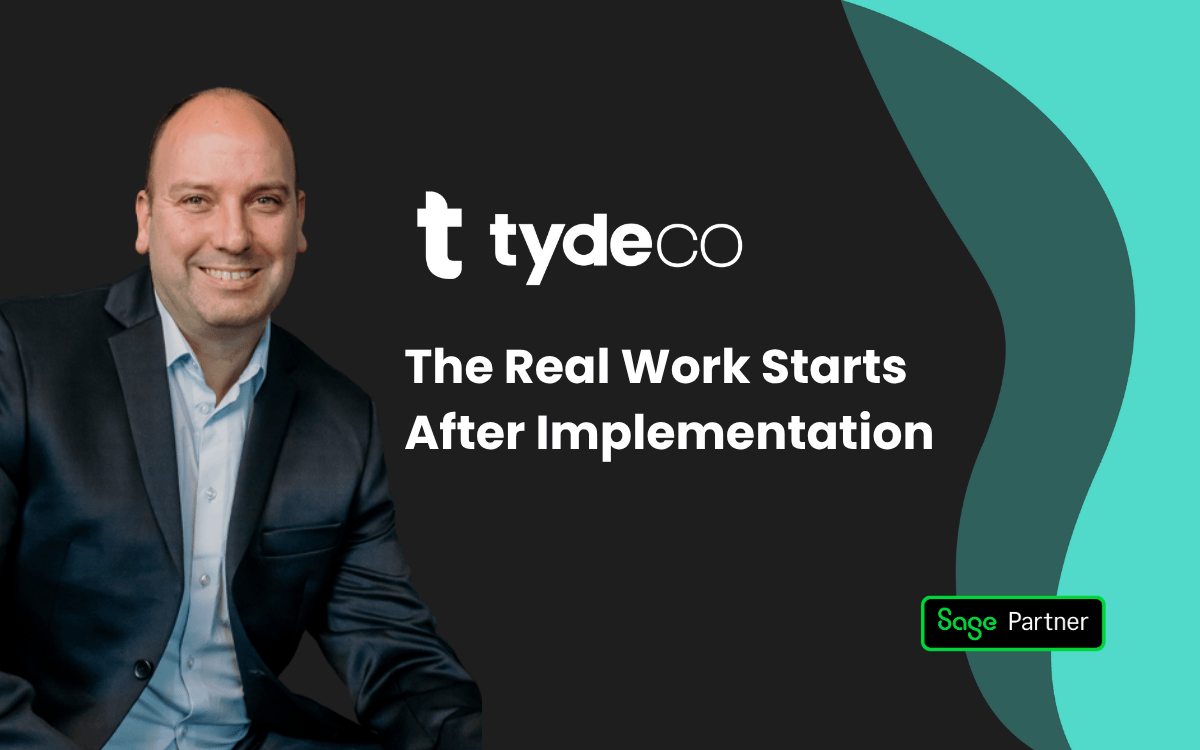
By Jeff Ryan, Managing Director, ERP of TydeCo™
Too many ERP rollouts stop at go-live. The system is working, the configuration matches the brief, and the project is technically “done.” But the business? Still confused. Still running Excel workarounds. Still underwhelmed.
I’ve seen this play out across industries—from wine farms to SaaS firms to financial services. As someone who’s led hundreds of Sage Intacct and HR implementations, I can tell you: the biggest driver of success isn’t technology. It’s the relationship between people, processes, and the platform.
Here’s what actually makes an ERP project deliver long-term value.
Go-Live ≠ Done
Just because the system is working doesn’t mean it’s working for the business.
- Sometimes the signals are subtle—a shift in tone, a quiet sense of dissatisfaction
- The project met the brief, but users feel lost or unsupported
- The real gap is often training and empowerment, not configuration
That’s why we made post-go-live audits and structured training mandatory. If your users aren’t confident, they’ll blame the system—even when it’s doing exactly what it should. And that frustration always makes its way back to the person who approved the project.
Empowerment is everything. People need to know not just how to use the system, but how to get the most out of it.
 Jeff Ryan, Managing Director, ERP
Discovery Isn’t a Checklist
Discovery isn’t about ticking boxes. It’s about building trust—and getting curious.
- We call our approach “selling through curiosity” because it’s all about digging deeper
- One question leads to another, and that’s where the real insight lies
- We train our teams to listen not just to respond, but to understand
When you take the time to ask that third or fourth follow-up, you uncover the real goals. It’s not just about feature lists—it’s about business evolution. That’s why many of our client relationships last decades. We don’t just build systems. We build context.
Jeff Ryan, Managing Director, ERPIntegration Without the Headaches
Years ago, we relied on custom development to link systems. It worked—until it didn’t.
- When one developer held the key to solving an issue, the risk to reputation was too high
- We shifted to iPaaS platforms that are scalable, supported, and easy to maintain
- Our role changed—from custom builder to strategic integrator
Now, we can connect finance, billing, project management, and payroll with confidence. We ask the key question: is payroll driving billing, or is it the other way around? That’s how we design flows that reflect reality—not just system requirements.
Jeff Ryan, Managing Director, ERPStop Rebuilding Excel in a New System
One of the biggest traps is trying to rebuild your spreadsheet inside your ERP.
- Sage Intacct is dimensional by design—it’s real-time, flexible, and deep
- You don’t need 40 expense accounts when you can tag dimensions like location, product, or employee
- Once tagged, that data becomes filterable, sortable, and instantly visible
We’ve seen clients transform how they understand their business. From restaurants tracking profitability per square meter to finance teams eliminating manual reporting entirely.
But that shift only happens if you stop trying to replicate the old way. Instead, ask: “What do we wish we had visibility on?” Then design the system around that.
Jeff Ryan, Managing Director, ERPERP isn’t about going live. It’s about staying live—and evolving with your business. That means continuous engagement, relentless curiosity, and a people-first mindset.
The best implementations don’t end with handover. They begin with partnership. That’s how you build something that lasts.
Learn more about how Sage Intacct supports connected finance and integrated growth.